
A cycling physics sandbox — not a game
The back of the pack: easier on average, violent in the moment.
Clone yourself ten kilos lighter, put one of you on the other's wheel, and watch what each version has to do as the road tilts. Hold the Wheel works out the watts — from your mass, your height, your drag area and how big a gap you leave — and shows you where being light stops being a luxury.
Free, with nothing to buy and no trial that runs out.
Watch
Six identical riders. One paceline. Six different hills.
Twenty seconds that make the whole argument. Same mass, same height, same fitness, all six holding one speed — and at the instant the group crests a roller, the rider on the front is doing 225 W and the rider at sixth wheel is doing 501 W — the price of holding that wheel exactly.
They are eleven meters apart. That is enough to put them on completely different parts of the same hill.
The whole argument, in six bars
Identical riders. 225 W to 501 W.
Six riders of the same mass, the same height and the same fitness, on half-meter wheel-to-wheel gaps over a 6 % roller. Bikes included, that strings six riders across eleven meters of road — which puts the front rider on −4.0 % and the last one still on +2.2 %.
Front of the group on the left, sixth wheel on the right
The simulation holds every rider rigidly on the wheel in front, so the entire mismatch is paid in watts. A real rider lets the gap stretch and closes it later instead. So 501 W is the price of holding that wheel exactly — the app's name, stated literally — and not a claim about what a head unit reads.
The same two riders, one hill apart
Nothing changed but the road.
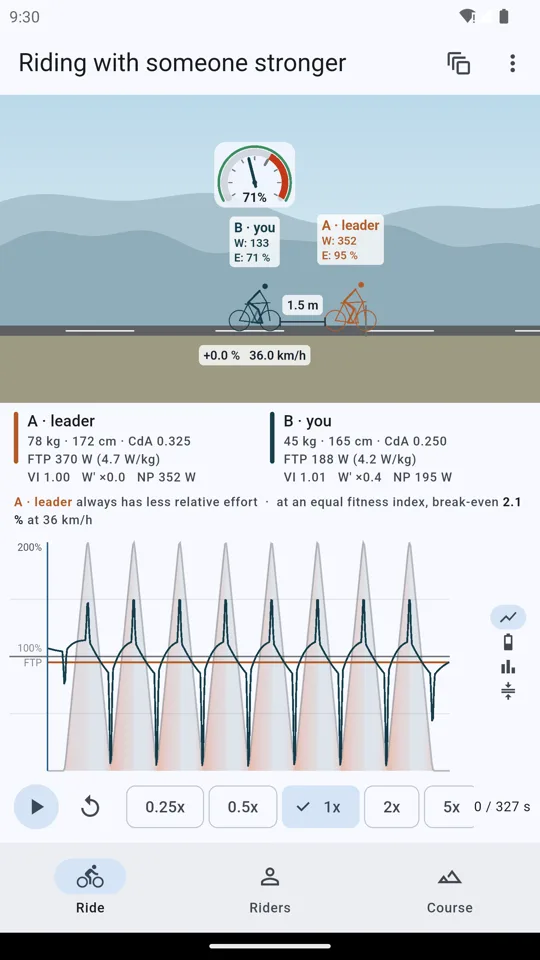
A 78 kg leader, with a 45 kg rider 1.5 m back on their wheel. The leader keeps working at the same 352 W the whole way. The rider behind goes from comfortable to over their limit — because the road tilted six percent.
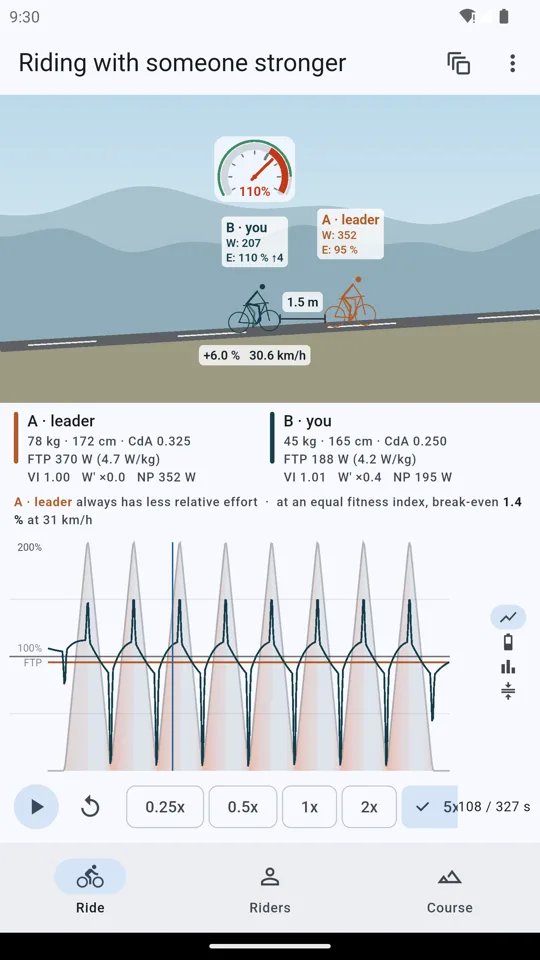
| Rider | Flat · 36 km/h | +6 % · 30.6 km/h |
|---|---|---|
| A · leader 78 kg · 172 cm · CdA 0.325 | 352 W · 95 % | 352 W · 95 % |
| B · you 45 kg · 165 cm · CdA 0.250 | 133 W · 71 % | 207 W · 110 % |
The one number worth knowing
The grade where aero stops mattering.
On the flat at 45 km/h, aerodynamic drag is 80–85 % of the power demand. Mass barely enters, drafting is a multiplier on your drag area rather than a flat saving in watts, and the limit is the lighter rider's absolute power.
On a 6 % climb at 20 km/h that aero term has collapsed by a factor of (20/45)³, gravity takes over, and watts per kilogram rules instead. The grade where those two swap is the single most informative number in the app — and it moves with speed.
At the speeds a group ride actually takes a roller, nearly every rise favors the lighter rider. That is the intuition this is built to give you.
How riders are modeled
Nothing here is a number you can set to something flattering.
Every rider property is derived, not dialed in. That is what makes a result worth trusting when it surprises you.
Height costs you
Drag area comes from height and mass through Du Bois body surface area. A taller rider pays for the height, every time.
Big riders are not superhuman
Critical power scales as mass^0.67, not linearly. Holding
watts per kilogram constant across masses quietly breaks that, so
the app refuses to.
Rolling terrain accumulates
Anaerobic reserve scales roughly linearly with mass, which is why rolling terrain builds a real cost instead of washing out over the run.
Drafting is not free watts
The draft reduces your drag area rather than subtracting a fixed number of watts — so its benefit falls away on a climb exactly as it does for a real rider.
Kinetic energy traded for height cancels mass, and so does rolling resistance. Only aerodynamics breaks the symmetry between riders. If a result seems to favor the heavy rider through inertia alone, that is the model being honest, not a thumb on the scale.
Build the road
Your hill, your numbers.
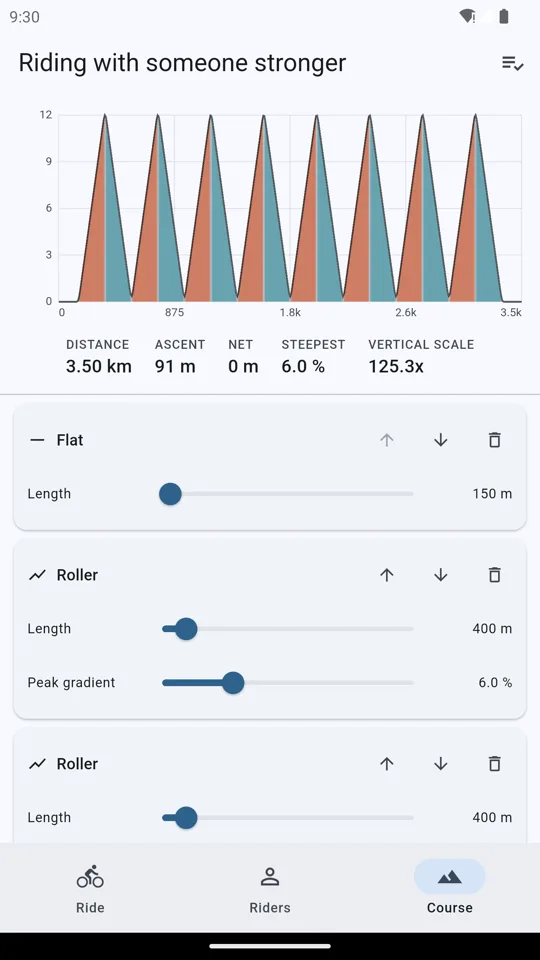
Lay out a course segment by segment — flats, climbs, descents and rollers, at lengths and grades you choose — then read off where each rider gains and loses.
The whole run is computed up front, so you never wait to arrive somewhere: tap the elevation profile and you are there, exactly, with every readout for that instant.
Where the work happens
Solved on your phone, in front of you.
There is no server working any of this out. The whole run — every rider, every meter, every watt — is computed on the device before you press play, which is what lets you tap anywhere on the elevation profile and arrive there instantly instead of waiting to ride to it.
It also means a tunnel, an airplane or a mountain pass with no reception makes no difference to it.
Before you try it
The four things people ask.
- Is Hold the Wheel a game?
- No. There is no score, no winning, nothing to unlock and nobody to beat. You set up riders and a road, and read what the physics says it costs them. It is a sandbox for building intuition, not a race.
- Do I need a power meter, or any hardware?
- No. Nothing connects to anything. You type in mass, height and a fitness figure, and the app derives threshold power, drag area and anaerobic reserve from those — so it works just as well for a rider you have invented as for yourself.
- Does it work offline?
- Yes. The simulation is solved on your device rather than by a server, so airplane mode, a tunnel or a mountain with no reception makes no difference to it.
- What does it cost?
- Nothing. No purchase, no subscription, no in-app purchases and no trial that expires.
Find out what that wheel is costing you.
Free, on the phone in your pocket or in the browser you already have open.